


The ADRO V2 Kit: Redefining the Toyota GR Supra's Form and Function
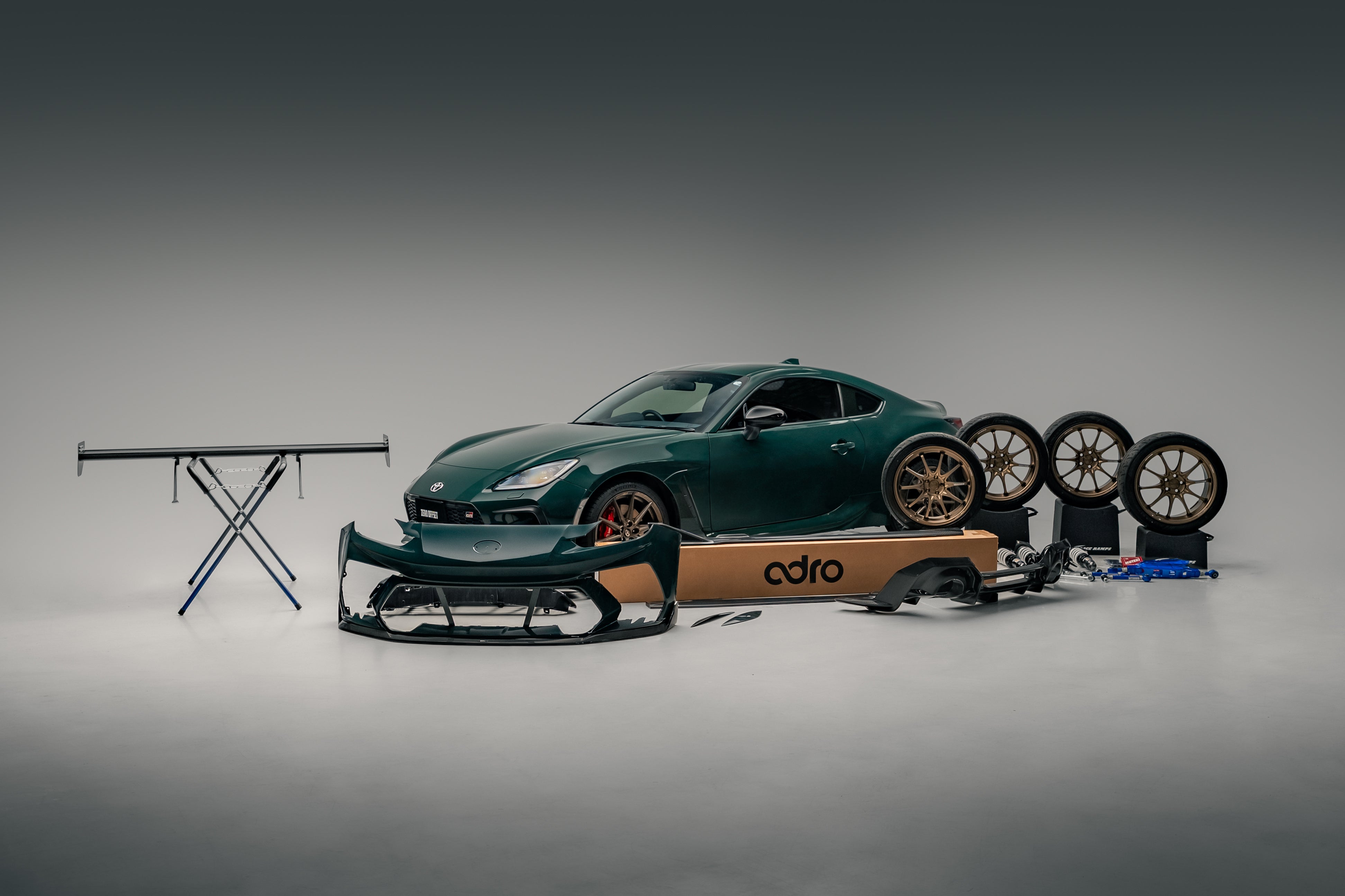
If you caught our build video, "Building the Cleanest Toyota Supra in 30 Minutes," you already know this wasn't your average bolt-on job. We packed a full ADRO complete body kit, Rays wheels, an FI Exhaust, Ohlins suspension, and an Armaspeed Intake. By the time we got to that front end reveal on camera, it was clear the ADRO V2 kit was the star of the whole build.
If you haven't watched it yet, do yourself a favor and check it out before (or after) reading this. Seeing the V2 kit go on panel by panel tells half the story that photos alone just can't capture. But for everyone who has watched, or wants the deeper dive into why this kit looks and performs the way it does, here's the full breakdown.
ADRO isn't just another name that showed up on our shelves. What started as a passion project between two racing enthusiasts has grown into one of the most respected names in aerodynamic body kits...and their V2 kit for the Toyota GR Supra, the same one featured in our build, is the clearest example yet of why. This isn't just a body kit that makes your Supra look meaner in a parking lot. It's a piece of engineering built from real testing data, aerospace-grade materials, and a design philosophy that treats form and function as the same problem.
Who Is ADRO?
 The ADRO V2 Carbon Fiber Front Lip. (Source: ADRO US)
Aerodynamic Development Race Optimization — ADRO for short — was founded in 2020 by Dongwan Yoo and Sean Yoon, two co-founders who bonded over a shared obsession with race car aesthetics and performance. What began as building custom kits for the KDM scene as a hobby quickly turned into a full-fledged company once demand caught up with their reputation. Today, ADRO's team draws on backgrounds in aerospace and Formula 1, working alongside automotive designers to build carbon fiber aero parts for platforms like the BMW M3/M4, the Porsche 992 GT3, and of course, the Toyota GR Supra.
That racing pedigree matters, because it shapes everything about how the V2 kit was designed. Every ADRO part starts with a 3D scan and CFD analysis of the factory car before a single piece of carbon fiber is laid.
Race-Grade Only
If you watched us unbox and test-fit these panels in the build video, the first thing you probably noticed was how the parts felt in hand before they even touched the car. The first thing you notice when you get your hands on an ADRO component is the material quality. The V2 kit's front lip, canards, side skirts, and diffuser are constructed from prepreg carbon fiber, the same "pre-impregnated" composite material used widely in motorsport and aerospace applications. Unlike standard wet-layup carbon fiber, prepreg carbon is cured under controlled heat and pressure, which results in a more consistent resin-to-fiber ratio throughout the part. In practical terms, that means a stiffer, lighter, and more dimensionally stable component that resists warping or flexing at speed.
This matters more than it might seem. An aero part that flexes under aerodynamic load doesn't just look bad, it changes the airflow it was designed to control, undermining the very performance gains the part exists to deliver. ADRO's use of prepreg construction across the V2 kit ensures the aggressive lines and vents hold their shape whether you're cruising the highway or pushing the car at track speeds.
The AT-R2 rear wing takes this a step further, with taller 95mm prepreg carbon fiber uprights designed to maximize both strength and weight savings. You can see just how substantial this wing sits on the deck once it's mounted in our build video — it's not a wing that flexes or hums at highway speed, it plants.
 The ADRO AT-R2 Swan Neck Wing, delivering 250+ lbs of downforce at 110 mph. (Source: ADRO US)
Real Aerodynamic Testing, Not Just Marketing Claims
This is the part we couldn't fully capture in a 30-minute build video, but it's just as important as anything you saw us bolt onto that car. This is where the ADRO V2 kit separates itself from a lot of the body kits on the market that are styling-only. Every component in the kit has gone through Computational Fluid Dynamics (CFD) analysis — the same digital wind-tunnel process used in professional motorsport to simulate and optimize airflow before a physical part is ever produced.
The results, according to ADRO's published testing data, are significant:
- The V1 front lip paired with ADRO's full front aero kit produced a 970% increase in downforce with only a 10% increase in drag at 180 km/h.
- The complete ADRO front end produces over 3x the downforce of the stock GR Supra front fascia.
- The AT-R2 swan-neck wing alone generates 250+ lbs of downforce at 110 mph.
- New vents positioned behind the front wheels reduce high-pressure buildup, letting air move cleanly along the car's sides instead of ballooning around the wheel wells.
What's especially notable is how ADRO approached the balance of the car, not just the front or rear in isolation. The stock GR Supra actually produces a small amount of aerodynamic lift at the rear. Rather than just chasing big downforce numbers up front, ADRO engineered the diffuser and AT-R2 wing specifically to offset that rear lift, meaning the front and rear axles gain grip together instead of shifting the car's balance and making it feel unpredictable at speed. That's the difference between a kit that looks fast and a kit that's actually been engineered to make the car more stable and confidence-inspiring at the limit.
The V2 front lip pushes this further than the original V1 design. It's built to pair with ADRO's prepreg front bumper canards, working as a combined system rather than a bolt-on afterthought, wider, with more front overhang, specifically to build on the downforce numbers the V1 kit already established.
Styling That Follows Function
ADRO's design language for the V2 kit didn't happen by accident, and it isn't purely about aggression for aggression's sake. Every visual change ties back to either airflow management or the car's stance, and if you rewatch our build, you'll notice we spent extra time on the front-end reveal for exactly this reason. It's the moment where the whole design philosophy clicks.
The facelift front bumper sits noticeably lower and wider than the stock unit. The factory hump, a design holdover that didn't do much for the Supra's proportions, has been removed entirely, replaced by lines that follow the car's natural silhouette rather than interrupting it. The side intakes have been opened up and the fake vents (a long-standing point of criticism on the stock A90/A91 bumper) have been eliminated in favor of functional ones that actually move air.
The V2 front lip takes the original ADRO design and makes it wider and more aggressive, with additional front overhang. It's the evolution that longtime ADRO fans had been asking for, a bolder, more track-focused face without abandoning the details that made the V1 lip work aerodynamically.
The side skirts V2 feature bold fins and an integrated fender panel, both smoothing airflow along the car's flanks and visually stretching the car's proportions lower and wider.
 The ADRO Side Skirts V2, featuring integrated fender panels. (Source: ADRO US)
The optional widebody kit goes furthest of all, widening the car's stance for a genuinely race-inspired silhouette while keeping the same principle running through it: every wider fender and sculpted panel is there to improve airflow as much as it is to turn heads.
 The ADRO Widebody Kit Complete, combining a wider stance with full aero optimization. (Source: ADRO US)
The carbon hood removes the factory hump as well, for a lower and wider appearance that ties the whole front end together into one cohesive design language, matching the lines of the bumper instead of fighting them.
Even the AT-R2 wing's presence follows the same logic as an F1 swan-neck design: taller uprights don't just look purposeful, they clean up airflow to the wing's underside for more efficient downforce production.
Why It Matters for Supra Owners
The GR Supra is already a capable platform, but the stock aero package was never designed with track use in mind — it was tuned for daily-driving refinement, not outright grip. The ADRO V2 kit closes that gap. Rather than treating the Supra's aerodynamics and its styling as two separate projects, ADRO built a kit where the CFD-validated performance and the aggressive, track-inspired look are the result of the exact same design decisions.
For owners chasing lap times, that means genuine downforce gains with a modest drag penalty, better balance between the front and rear axles, and components engineered from materials that will actually hold their shape at speed. For owners who simply want their Supra to look like it means business, the payoff is a design that reads as intentional rather than bolted-on, a Supra that looks like it was built around this bodywork from day one.
That's the real takeaway with ADRO's V2 kit: it's not a choice between form and function. It's proof that, done right, they're the same design problem.
If you want to see all of this come together on a real car rather than just read about it, go back and watch "Building the Cleanest Toyota Supra in 30 Minutes." Watching the ADRO V2 kit go from individual carbon panels to a complete, cohesive front and rear end, alongside the Rays wheels, FI Exhaust, and Ohlins suspension that rounded out the build, makes it a lot easier to picture on your own car. And if it convinces you the way it convinced us, you know where to find us when you're ready to start your own build.

Leave a comment
This site is protected by hCaptcha and the hCaptcha Privacy Policy and Terms of Service apply.